Cardiac Cell Therapy Trials
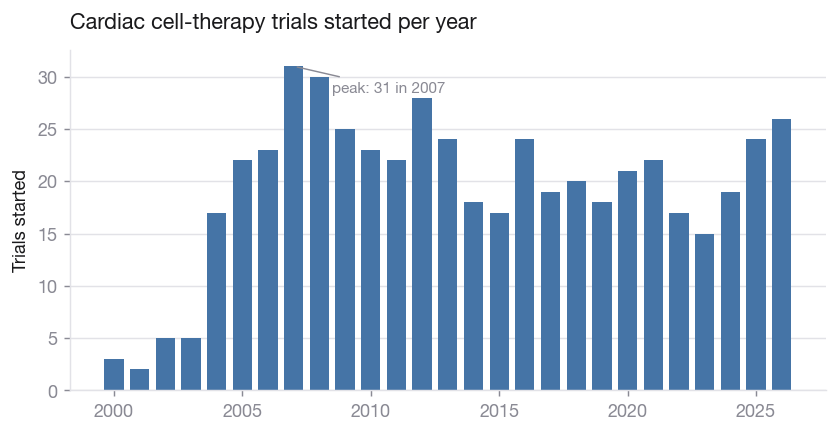
A registry-wide analysis of 528 interventional cardiac cell therapy trials, covering every study that has delivered cells into a human heart. New trial starts have declined steadily since a 2007 peak, and enrollment failure accounts for most terminations.
I built this as practice in scraping and analysing public data, so it should be read as a skills exercise. The findings summarise what is already present in the source dataset.
Question
Cardiac cell therapy has been in clinical testing for over two decades without producing an approved therapy, and the usual reading of that record is that the biology has not delivered. I wanted to test that reading against the registry itself, since published trials are a filtered sample of the trials actually run.
The analysis therefore covers every interventional trial registered as delivering cells to the human heart, and asks two things of each one: how far through the phase structure it progressed, and where it stopped early, what reason the sponsor gave.
Results
- New trial starts peaked in 2007 at 31 and have not approached that figure in the eighteen years since.
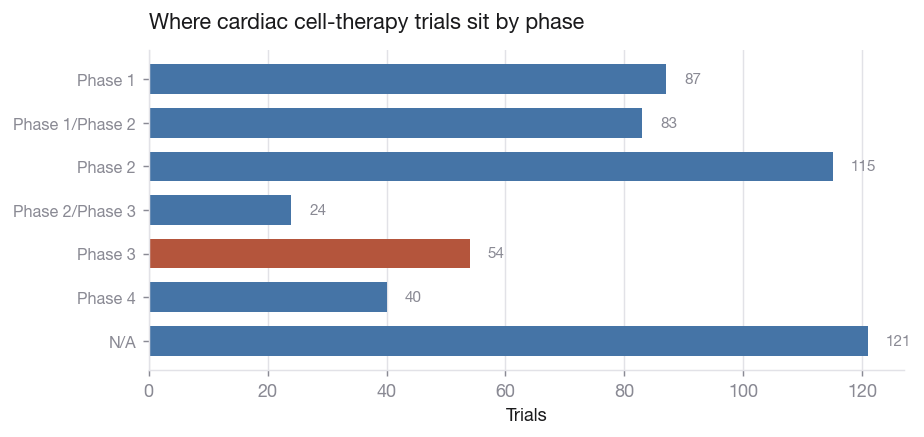
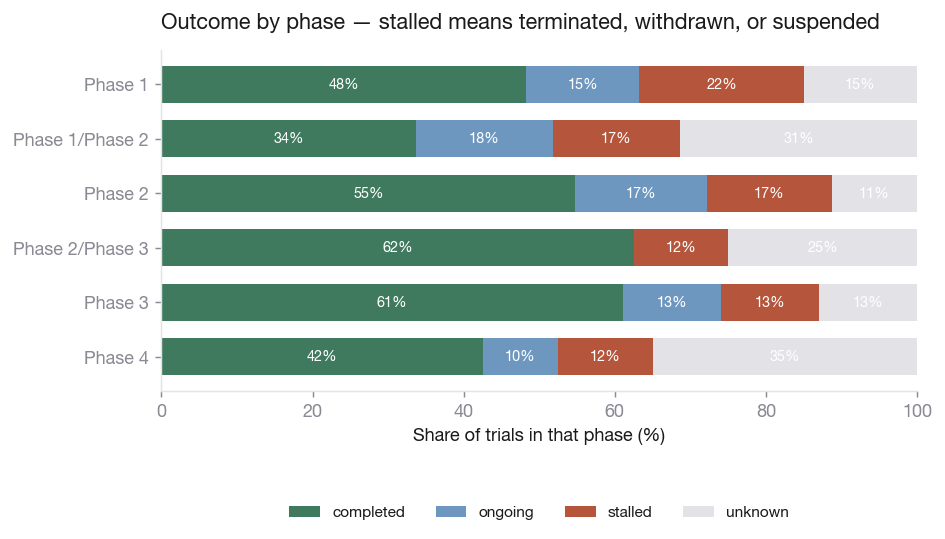
- Only 14.8% of trials reach Phase 3 or Phase 2/3, so the large majority terminate before the stage at which efficacy could be established.
- A further 16.1% stalled outright, whether terminated, withdrawn or suspended.
- Of the 74 stalled trials that state a reason, 28 cite slow or failed recruitment and 10 cite funding, while only 3 cite failure of the therapy.
- Only 23.6% of completed trials have posted results, leaving roughly three quarters of the completed work unreported.
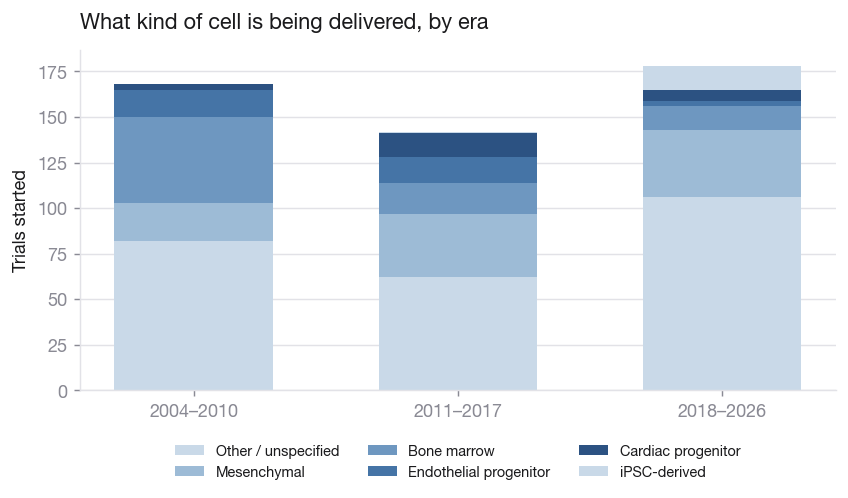
- iPSC-derived therapies account for 14 of the 528 trials, while bone marrow and mesenchymal approaches from the 2000s continue to dominate the registry.
Interpretation
- Because enrollment failure outnumbers efficacy failure by roughly nine to one among trials that give a reason, the contraction of the field is at least partly an operational problem of recruitment and funding, and the registry does not support reading the slowdown as a verdict on the underlying biology.
- With under a quarter of completed trials reporting results, the published evidence base is a small and non-random subset of the work carried out, so any meta-analysis drawing on the literature inherits that selection.
- Clinical evidence is accumulating for a different cell type from the one most current preclinical work uses, which implies a longer translational lag than laboratory progress on its own would suggest.
Figures
Method and limitations
Observational studies are excluded before any phase statistic is computed, since a registry entry without an interventional design carries no phase and including such records would skew every percentage. Cell type is classified from each trial’s own title and intervention text, which will misclassify a small number of trials that describe their product only in a protocol document. Reasons for stopping are self-reported by sponsors and are given by 74 of the stalled trials, so the distribution of causes is indicative only.